Implementation Guide
Local Logic's Local Content SDK is a simple, drop-in component that can be easily added to any property detail page.
Local Content provides an overview of nearby points of interest, accessibility and availability scores of those points of interest that are of most interest to homebuyers, and tools to help homebuyers quickly calculate their commute time from the listing to any location.
Implementation
Local Content is installed as an iframe that can be easily embedded on your site. Our iframe distribution model ensures the product always loads the latest available version of the SDK, meaning that required manual updates by our customers are rare.
Initializing the SDK
Local Content should be initialized with a latitude and longitude coordinate pair that represents the listing’s location. This coordinate pair sets the location of the home marker on the Local Content map, which indicates the listing location, as well as determines the center of the search radius from which nearby points of interest are displayed.
Coordinate pairs are typically included in most IDX feeds. If a coordinate pair is not available for your listing, many third-party geocoding services exist that can convert a provided address into a valid coordinate pair.
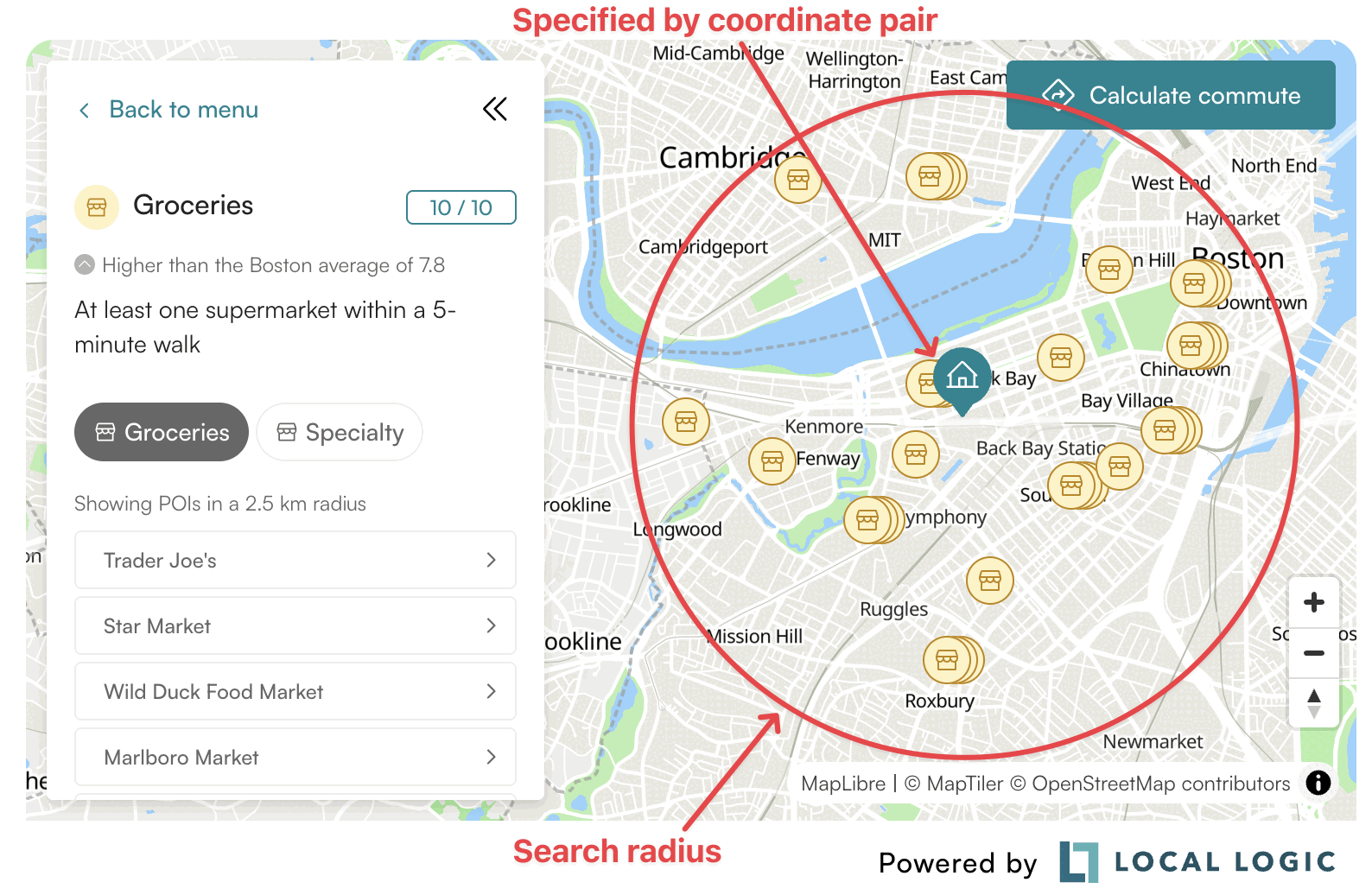
Other initialization options are also available, such as customizing the default color palette and font family, or fine-tuning the appearance of the Local Content sidebar. For the full list of available options, please see the Global options section of our documentation.
Choosing a basemap
By default, Local Content includes a streetmap-style basemap at no additional cost. However, you may also provide your own basemap, including any custom styles you have created for that map. This can be a useful option if you already have other custom-style basemaps on your website and are seeking a consistent experience for Local Content.
Supported basemap providers include MapTiler, Mapbox, and Google Maps. Note that providing your own basemap will require an additional key provided by you, meaning that you will incur all costs associated with that basemap. For more information, see the MapProvider section of our documentation.
Best Practices
Customize Local Content’s appearance to match your brand
Key colors in Local Content’s color palette can be customized to match your brand identity, giving the product a seamless appearance on your website. Additionally, you may also customize the font family displayed in Local Content to match the family already in use on your website. The image below shows Local Content customized with an orange key color and a serif font family.
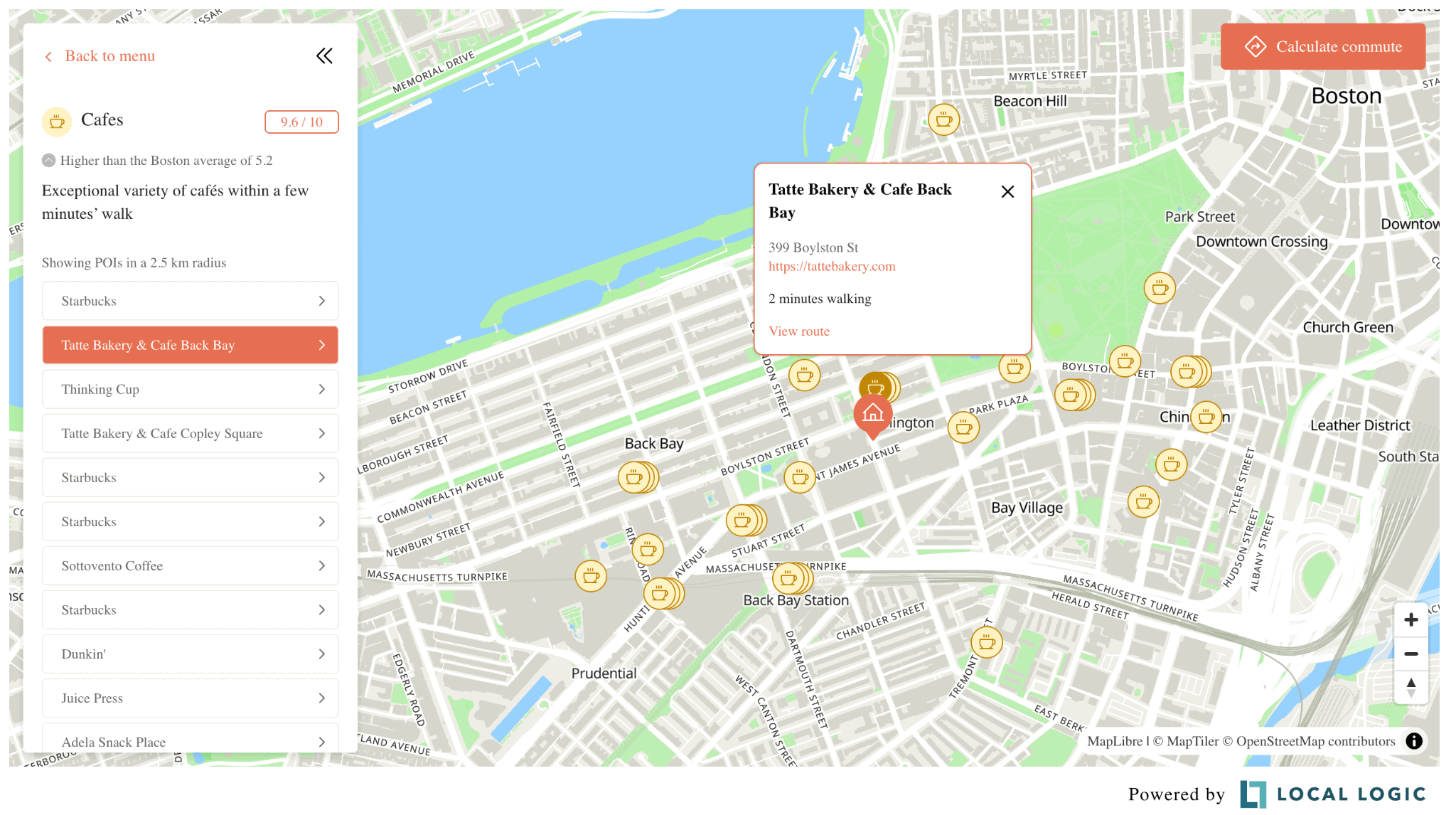
For more information regarding customizing the appearance of Local Content, see the Appearance section of our documentation.
Allocate appropriate space to Local Content
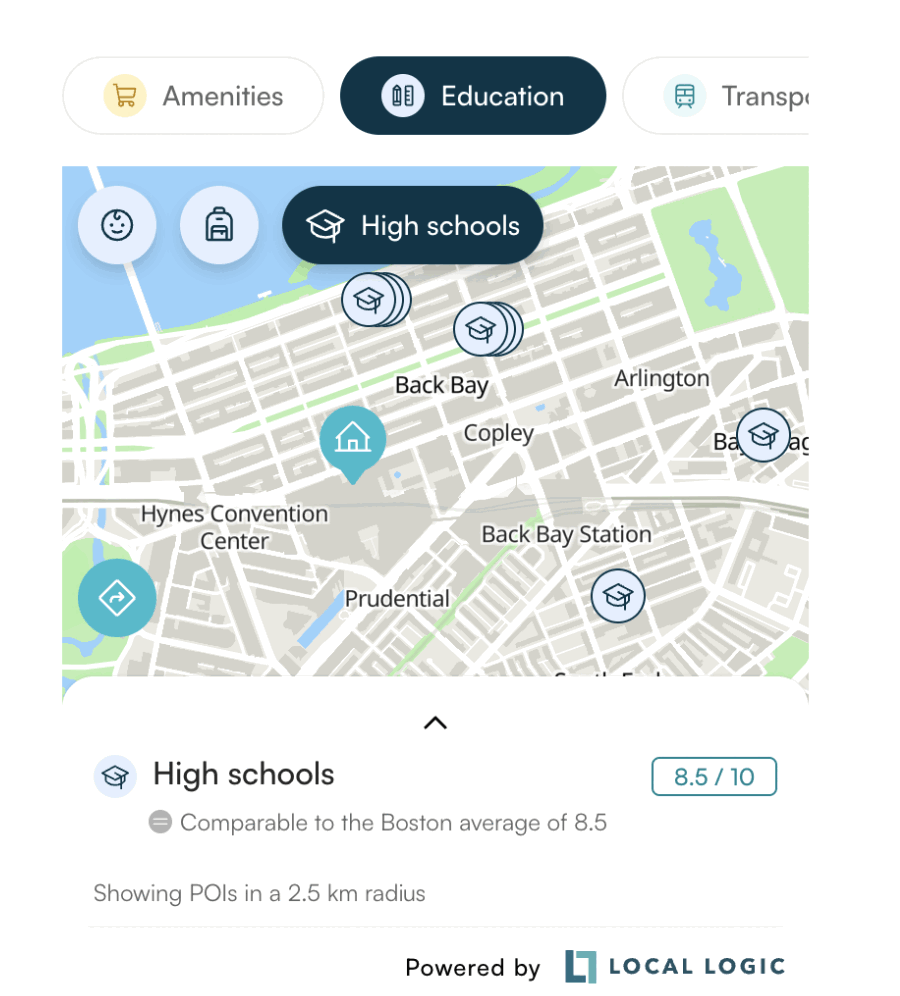
Local Content is designed to be displayed with a height of at least 700 pixels for the best user experience. Choosing a height of less than 700 pixels can lead to a suboptimal user experience by making certain UX components difficult to find or interact with.
Local Content is designed as a responsive SDK. When viewed or installed in a width of less than 640 pixels, Local Content will automatically convert to a vertically optimized mobile view as shown here.
Highlight the content most relevant to your listing
Local Content offers extensive customization options to focus on the content that is most relevant to your inventory. You may choose to hide points of interest that aren’t of interest to your homebuyers, or hide all associated scores.
Additionally, you have extensive control over the initial collapsed state of the sidebar as well as the display colors for each category, enabling you to customize Local Content to fit seamlessly into your site. For more information, see the ScoresMenu section of our documentation.