About our Data
Local Logic was founded on two beliefs:
-
Location has a huge impact on the way that cities are developed and how their citizens live their lives. Where you live shapes which transportation modes you'll use, what kinds of people you'll befriend, what ideas you'll be exposed to. Where you set up your store determines who'll shop there, what kind of clients you'll attract, how much money you'll make. Where you build a new transit station impacts how many people will use it, how the land around it will develop, how nearby transportation patterns will change.
-
Communicating the value of location is hard. People have long known that some locations are much more valuable than others, but quantifying that value has been challenging. Valuing more tangible things is straightforward: it is obvious that, all other things being equal, a 3-bedroom house is more valuable than a 2-bedroom one. But location is different; it is not necessarily obvious why a property on one street might be more valuable than a similar property two streets to the south. There are a few reasons for this:
- Location is multi-faceted. Things like distance to amenities, transportation options, demographics, street appearance, noise levels, and so on all factor into the value of a location.
- Location means trade-offs. There is no perfect location. It's convenient to live close to a highway if you travel frequently, but then you have to deal with the noise. It's great to have frequent transit within walking distance, but that requires a high population density, which means less space for everyone. As you get closer to one amenity, you get farther from other ones.
- The experience of a location can be hard to explain. If you walk down two commercial streets in two different cities, you will likely prefer one over the other. However, you may not be able to articulate why you prefer it. Numerous factors play into these kinds of preferences — everything from the architecture to the consistency of the building setbacks to the building heights to street widths to tree sizes to traffic volumes. It's hard to pin down why a location evokes a certain feeling, positive or otherwise.
- Different people value different aspects of location. A family with young children might be well served by being close to schools. A college student might want to live close to bars. A dress shop might benefit from being near other clothing stores. A factory might need a railway or an airport nearby to ship goods. Everyone wants different things in a location.
For all these reasons, it's hard to put a clear value on a location.
These two beliefs are why Local Logic exists: to make the value of location quantifiable and queryable across every dimension that shapes a place.
Our data foundation
Local Logic's data covers more than 250 million addresses across the United States and Canada, built on 100 billion+ unique location data points drawn from public, proprietary, and partner sources. The data is exposed through a set of products that, taken together, describe a place from several complementary angles: how it scores on lifestyle dimensions, what's near it, who lives there, and how its surrounding neighborhood and market behave.
The sections below walk through each product family and link out to its API reference.
Location Scores
Our Location Scores are a collection of numerical ratings that evaluate different aspects of a location — things like transit quality, access to restaurants, and quietness. They are designed to be human-readable, so that they can be surfaced directly in consumer-facing experiences without further interpretation.
We have 18 scores in total, across six broad categories. We did not develop a single, unified score to rate a location, as not everyone values the same things in a location. A family with young children and a young professional looking for nightlife are both well-served, but by different scores.
This PDF describes what the values of 0-10 mean for their respective scores.
→ Location Scores API documentation
Points of Interest & Schools
Points of Interest (POIs) cover the places that shape daily life around any given address — groceries, restaurants, cafés, nightlife, transit stops, parks, and more — across the US and Canada. POIs can be retrieved around a coordinate or within a geography, with categories, brands, and tags available for fine-grained filtering. POIs power both map rendering and proximity analysis, and are the underlying signal behind several of our Location Scores.
Schools are maintained as a dedicated dataset, with separate coverage for the US and Canada to reflect the differences in how each country publishes school data. The dataset includes primary and high schools with location, type, and the contextual information needed to answer "what are my school options here?" at the level of an individual address.
→ POIs API · Schools API
Demographics
Granular demographic data across the US and Canada, queryable by coordinates or by geography. Available attributes vary by country to reflect what each national statistics agency publishes — but the API returns the same response shape either way, so that consumers can compare across markets without writing two integrations.
Demographics power use cases ranging from market sizing and site selection to consumer-facing neighborhood summaries.
Geographies & Neighborhood-Level Insights
Where individual addresses tell you about a single point, neighborhoods tell you about a context. This part of the data foundation describes places at the level real estate buyers, investors, brokers, and developers actually evaluate.
Geographies
Geographies such as neighborhoods, cities, metro areas, are the named places we maintain and the spatial framework that the rest of the neighborhood-level products are computed against. Local Logic maintains over 150,000 neighborhood boundaries across the US and Canada, and supports custom boundaries when our standard set doesn't match how you think about a market.
Profiles
Profiles are narrative descriptions of what a neighborhood is like, generated from the underlying data, and are suitable for display in consumer-facing experiences. A profile can be retrieved by geography ID or by coordinates, and is designed to give an end user a quick, readable sense of a place without requiring them to interpret raw scores or statistics themselves.
Similar Neighborhoods
Similar Neighborhoods rank the neighborhoods most similar to a given geography, based on the full set of Local Logic features. It powers buyer-side discovery ("I love this neighborhood — where else might I look?").
Value Drivers
Value Drivers surface the features that most explain property values in a given neighborhood — for example, school access in one place, transit access in another, vibrancy in a third. It's designed to make the underlying market dynamics legible, so that anyone reasoning about a neighborhood understands what is actually driving the price rather than treating the price as a black box.
Market Statistics
Market Statistics provide real estate market data — price levels, trends, and related indicators — for US geographies. Available at the neighborhood, city, and metro level, it is built to sit alongside the other neighborhood-level products so that the qualitative picture (what a neighborhood is like) and the quantitative picture (what the market is doing) can be presented together.
Coverage: United States only.
Scale of analysis
Local Logic's data is designed to be requested at whatever scale your use case calls for. Through the APIs, you can ask for data at the level of:
- Address. The finest level of detail Local Logic provides. Location Scores, POIs, Schools, and Demographics can all be retrieved for a specific address (or its coordinates), across more than 250 million addresses in the US and Canada.
- Neighborhood. For context-level questions — Profiles, Similar Neighborhoods, Value Drivers, and aggregated Scores or Demographics — data is computed against our standard neighborhood boundaries or against custom boundaries you define.
- City, metro, and custom geography. For portfolio-level and market-level work, the same indicators can be aggregated to larger geographies, including ones you define.
Why address-level granularity matters
The base spatial unit at which location data is computed determines how useful that data actually is. Too coarse and you erase the variation that makes one address desirable and the one across the street not — and that variation is often the entire point of looking at the data in the first place.
Most products in this space compute at one of two scales, and Local Logic has deliberately moved past both:
Neighborhood averages. Some location scoring products assign a single value to a whole neighbourhood:
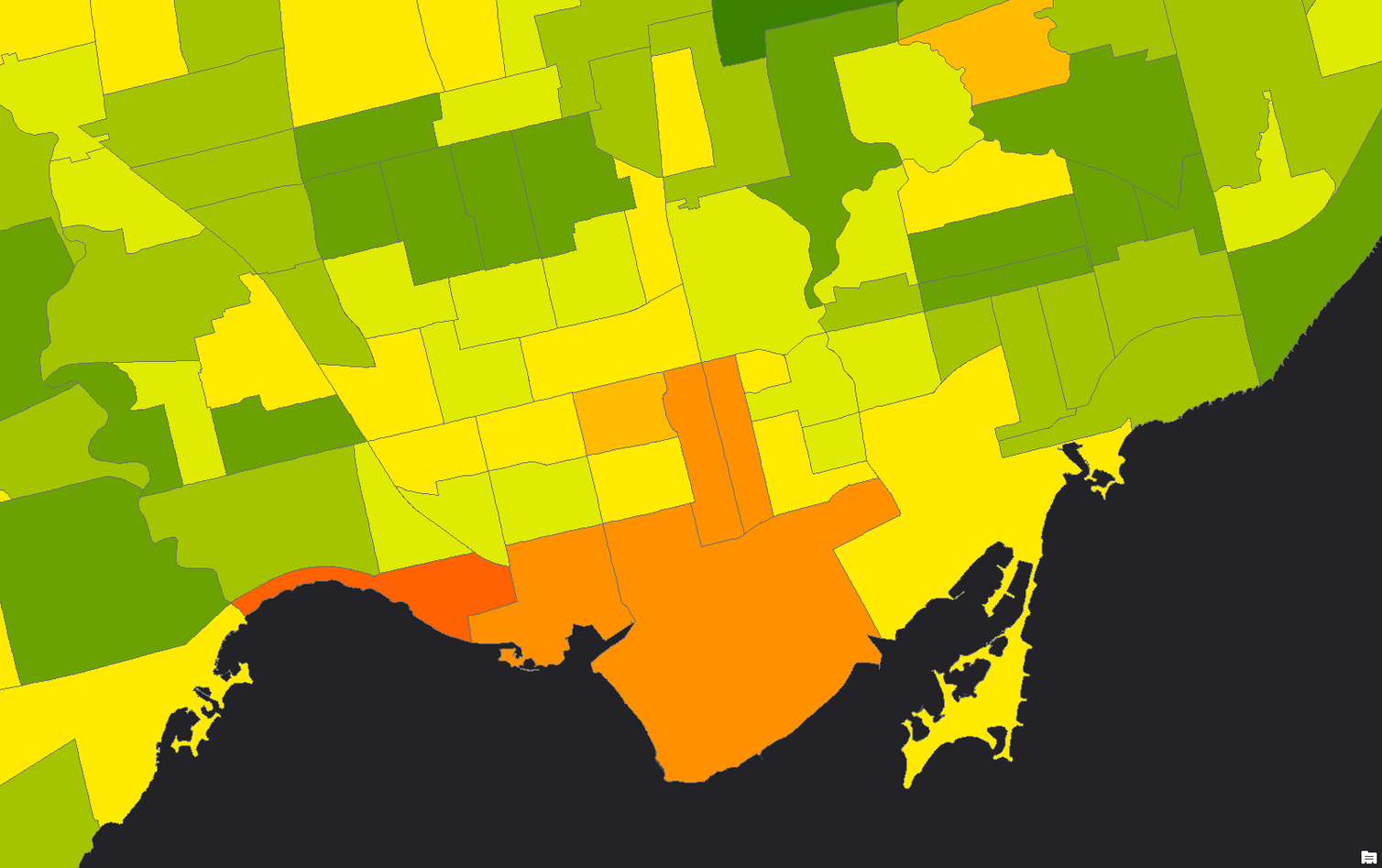
This is workable as a high-level view, but it tells you nothing about how a place varies internally — and most real decisions, whether a home purchase or a site selection, hinge on exactly that internal variation.
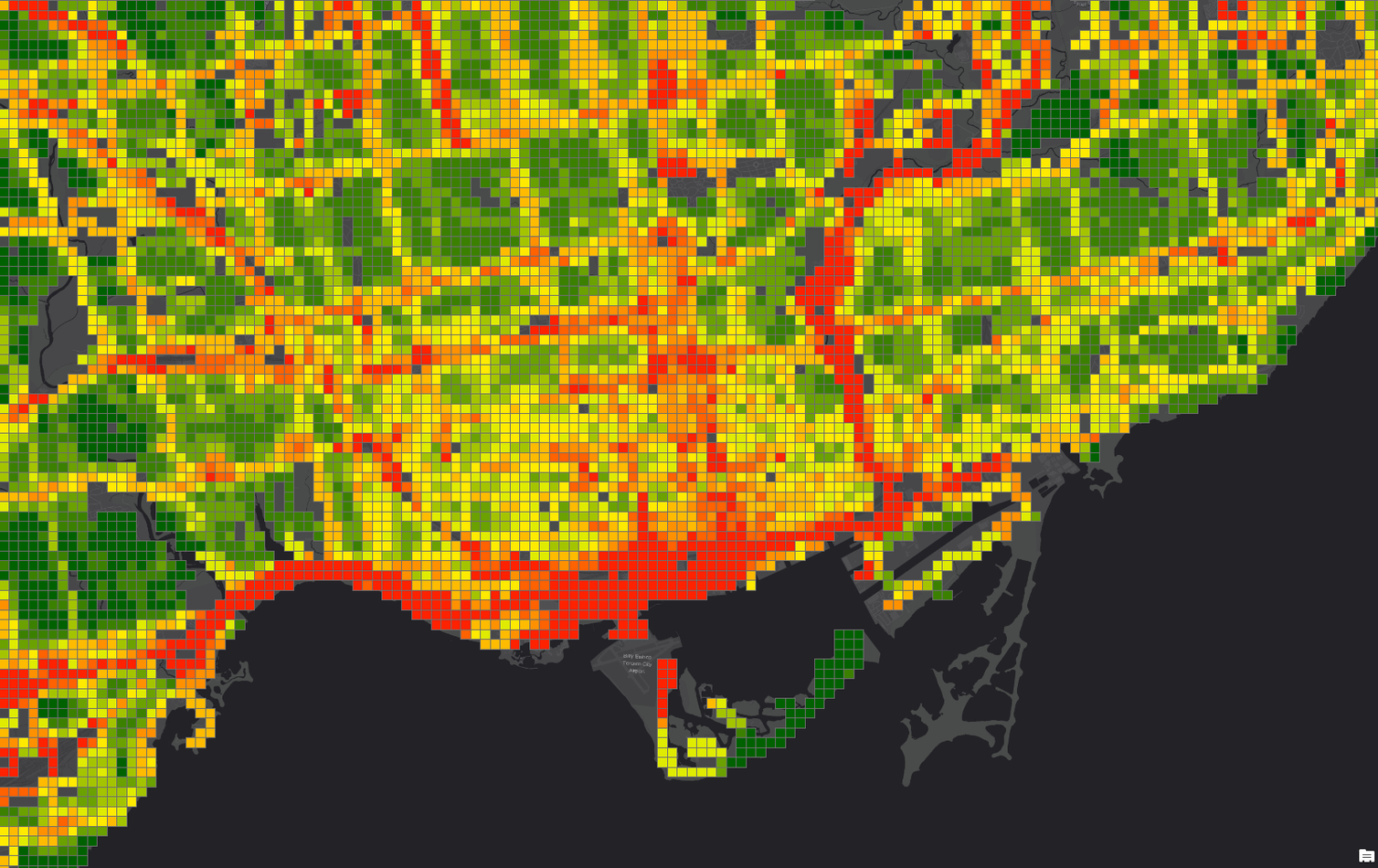
Coarse grid cells. Other products, like WalkScore, place a regular grid over a city and compute one value per cell. The cells are typically large — often hundreds of metres on a side — which gives mathematical regularity, but still washes out the differences between adjacent streets and adjacent buildings:
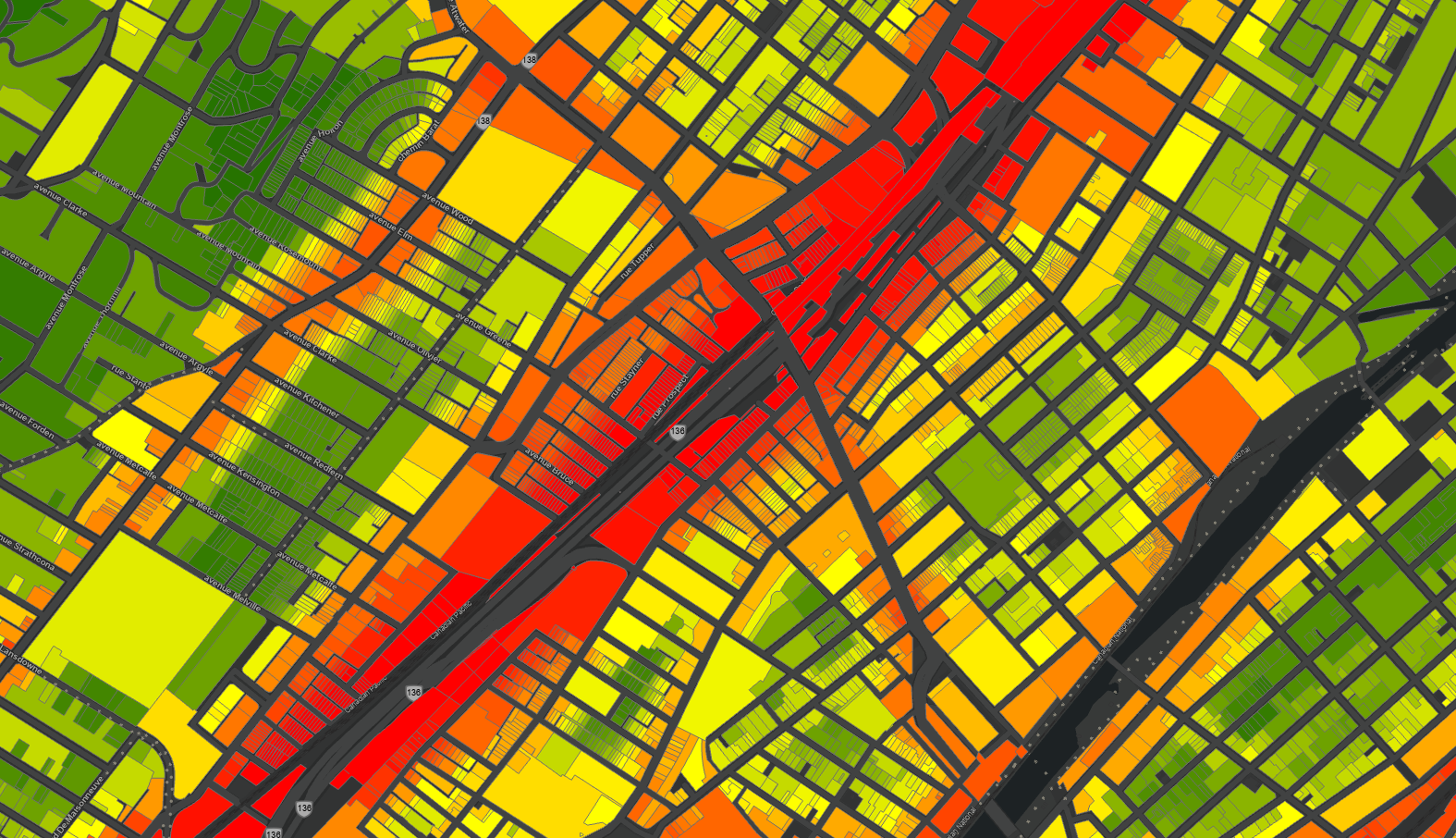
Address-level. Local Logic computes its Location Scores at a resolution roughly equivalent to a single mid-to-large building in a dense urban setting. At that resolution, scores vary meaningfully not just between neighbourhoods, and not just between streets, but between addresses on the same block — which matches how end users actually evaluate location decisions. A commercial corner and the residential addresses behind it can carry distinctly different scores, as they should.
This is the level of detail that makes the data usable for real decisions: pricing a specific listing, evaluating a specific site, or showing a buyer what life would look like at a specific door.
Coverage
Local Logic data covers the United States and Canada. A few products have coverage notes worth knowing about up front:
- Market Statistics — United States only.
- Demographics — available attributes vary by country, reflecting differences in what each country's statistical agency publishes.
- Schools — maintained as separate US and Canada datasets.
All other products are available across both countries.
Frequently asked questions
What does Local Logic's data cover?
Local Logic provides location intelligence across the United States and Canada, covering more than 250 million addresses and built on 100 billion+ location data points from public, proprietary, and partner sources. It spans Location Scores, Points of Interest, Schools, Demographics, neighborhood Geographies, Profiles, Similar Neighborhoods, Value Drivers, Market Statistics, and Climate Risk.
At what geographic scale is the data available?
Local Logic data can be requested at the address level — its finest resolution — and at the neighborhood level, then aggregated to city, metro, and custom geographies. Address-level scores can differ between two addresses on the same block, which is the resolution most real estate decisions actually depend on.
How often is the data updated?
Local Logic refreshes different data layers on different schedules: Location Scores monthly, Points of Interest monthly, Market Statistics daily, Demographics with each new census release, and Schools quarterly.
What is not covered?
A few products have coverage boundaries worth knowing up front: Market Statistics is United States only; wind risk (part of Climate Risk) is United States only; Demographics attributes vary by country because each national statistics agency publishes different fields; and Schools are maintained as separate US and Canada datasets. All other products are available across both the US and Canada.
Which products are available in the US vs Canada?
| Product | United States | Canada |
|---|---|---|
| Location Scores | ✅ | ✅ |
| Points of Interest | ✅ | ✅ |
| Schools | ✅ | ✅ (separate dataset) |
| Demographics | ✅ | ✅ (attributes differ by country) |
| Geographies / Profiles / Similar Neighborhoods / Value Drivers | ✅ | ✅ |
| Market Statistics | ✅ | ❌ (US only) |
| Climate Risk | ✅ (incl. wind) | ✅ (no wind; some hazards differ — see the Climate page) |
How is Local Logic different from neighborhood-average or grid-based scores?
Most location products compute one value per neighborhood or per large grid cell, which washes out the differences between adjacent streets. Local Logic computes at the address level, so a commercial corner and the homes behind it can carry distinctly different scores.